
Why fuel-oil histories punish the next employment
Product tankers that have carried heavy fuel grades often keep a stubborn film along longitudinals, heating coils and shadow zones behind framing. That film is not “dirt” in a casual sense — it is a viscoelastic layer that keeps releasing hydrocarbons into wash water and vapour long after the free liquid has been stripped.
Demucking is the step that interrupts that cycle. Until the compacted and clinging mass leaves the tank, chemical washing mostly redistributes contamination rather than removing it.
What the residue actually does inside the tank
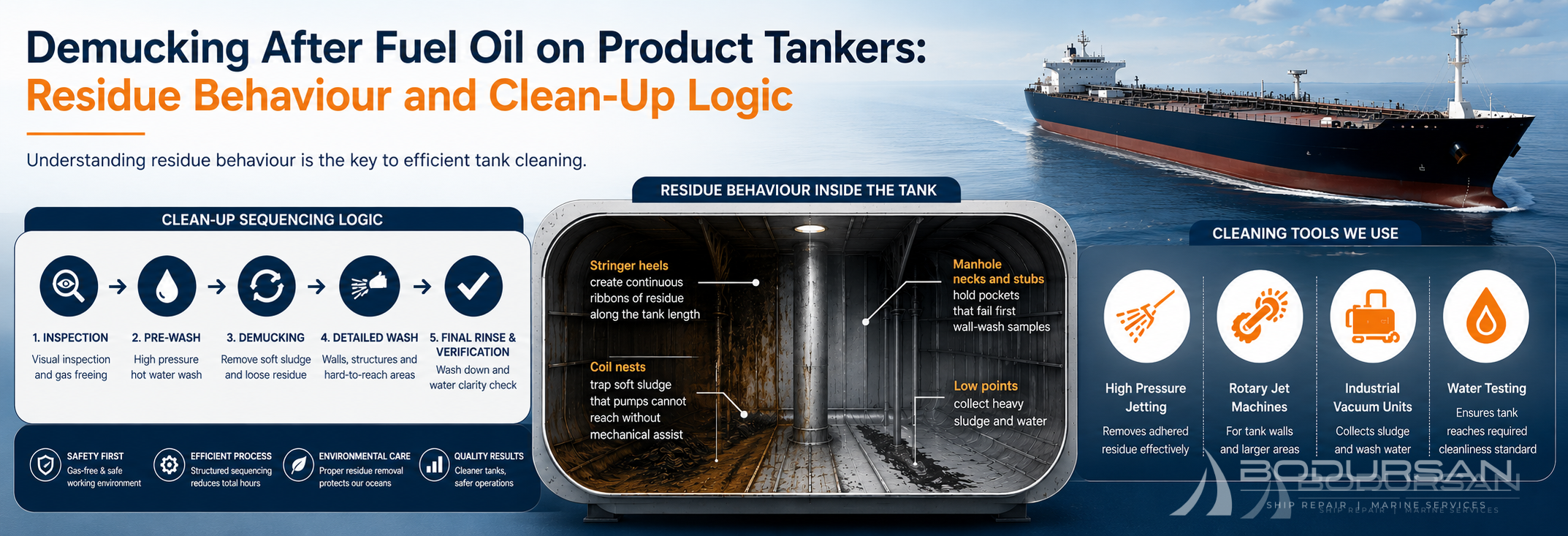
Fuel-oil leftovers settle toward low points but also migrate under temperature swings. Cold surfaces thicken the layer; warm pockets soften it just enough to smear onto adjacent plating. Crews that jump straight to detergent recirculation often report “clean water, dirty walls” — a classic sign that demuck volume was underestimated.
- Coil nests trap soft sludge that pumps cannot reach without mechanical assist
- Stringer heels create continuous ribbons of residue along the tank length
- Manhole necks and stubs hold pockets that fail first wall-wash samples
A sequencing logic that shortens total hours
Begin with drain and strip until returns run thin. Follow with targeted demucking of bottoms and known dead zones. Only then introduce compatible wash chemistry and, where coatings allow, HP/UHP jetting. Fine cleaning belongs at the end if the next charterer sets purity or wall-wash numbers.
Owners who brief last cargo density, pour point and approximate sludge height give the yard or riding crew a realistic labour model. Guesswork inflates both overtime and waste tickets.
Waste is part of the cleaning scope
Demucking after fuel oil generates sludge that must leave under controlled transfer. Treat reception capacity as a planning constraint, not an afterthought — see waste disposal in the demucking cluster and our operational demucking services page.
For mobilisation, send last/next cargo, tank list and location via contact. A clear brief is worth more than a vague “make it clean” instruction.